
Energy, water and decarbonisation
The future of food depends on the protection of natural resources. We invest on the efficiency of energy and water use across its operations and value chain to drive continuous resources optimization and to advance its decarbonisation pathway. Acting today means contributing to a food system that can endure and thrive over time.
Shaping a more efficient production system
Energy & water
Across our production sites, we work to use energy and water more efficiently, focusing on reducing energy consumption and increasing the self-production of energy, in particular from renewable sources. At the same time, we aim to improve water management, especially in areas with high water stress.
8.3
MWp energy power from photovoltaic plants.
196
more water recycled and reused in water-stressed areas compared to 2022.
Source: 2025 Sustainability Report, disclosure E1-4 (64); E3-3 (86).
Decarbonisation
At Barilla, our strategy to combat climate change involves reducing emissions, not only at its production sites but also throughout the supply chain. The Group is therefore investing more and more in renewable energy, and energy and water efficiency.
By 2025
17
in euros of energy-efficiency investments approved.
By 2025
10
in euros of photovoltaic installations investments approved.
By 2025
3
in euros of water efficiency investments approved.
The information and data contained in the report relate to Barilla Group for the period from 1st January to 31st December 2025, unless otherwise indicated. For information on the methodology, calculation criteria and reporting scope, please refer to the 2025 Sustainability Report,
For further details on decarbonization targets and levers and related financing see section "E 1-3: Actions and resources in relation to climate change policies" and "E 1-4: Targets related to climate change mitigation and adaptation".

Environmental Product Declarations
Environmental Product Declarations (EPDs) present the environmental impacts of Barilla products across their life cycle, calculated with the LCA methodology and category-specific rules of the International EPD® System.
Verified by an independent third party, the Barilla EPD System ensures transparent environmental communication. The EPD book outlines its origins, rules, and applications.
Energy & water management
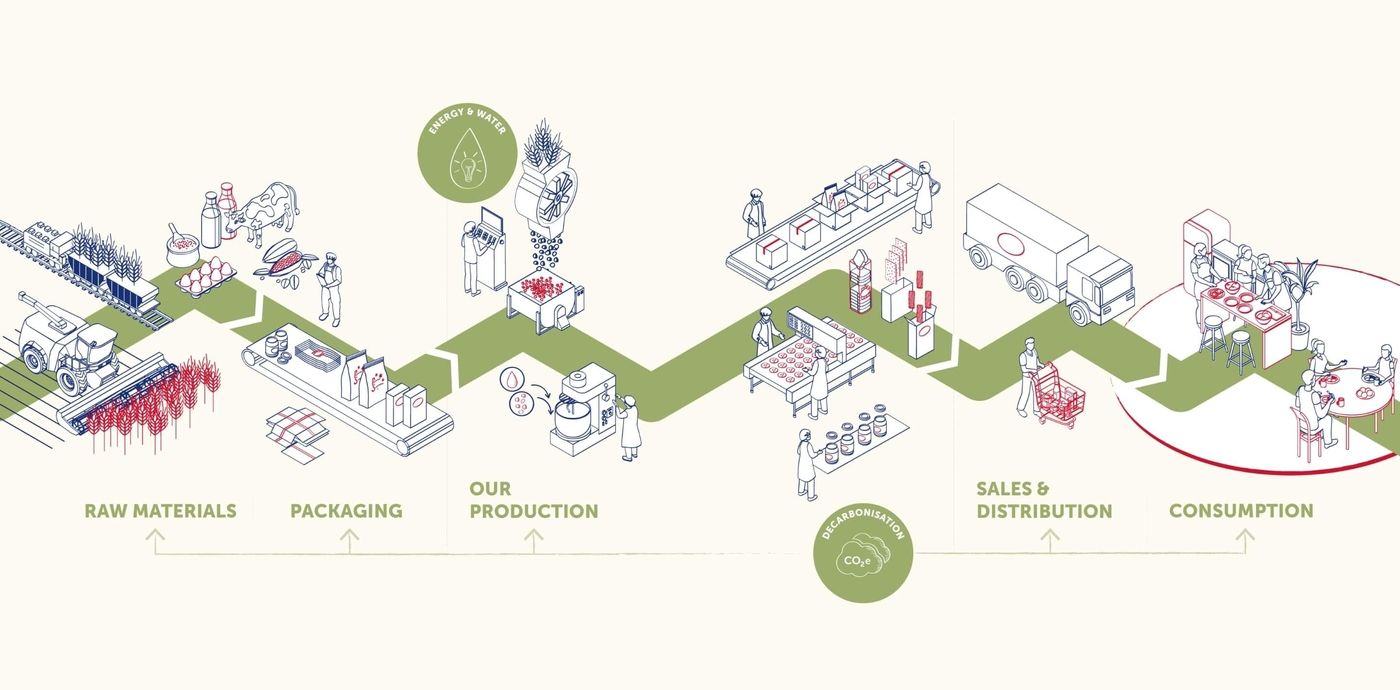
Energy and water are essential to every stage of production, from milling grain to making pasta, bakery products and sauces. For Barilla, improving how these resources are used is not only a technical challenge, but shared value across the organisation, involving engineers, plant teams and colleagues who work every day to make production more efficient.
Today, 28 plants are certified under the internationally recognised environmental management standard(ISO 14001) and 25 of them also under the energy management standard (ISO50001). Energy efficiency is paired with a growing use of renewable sources. In 2025, Barilla more than doubled the photovoltaic capacity installed across European production plants.
Water stewardship is another essential part of this work. For this reason, over the last three years, Barilla almost tripled the recycled water across its production plants in water-stress areas. Step by step, these efforts help strengthening the resilience of Barilla’s produc-tion system.
Energy & Water Goals and KPIs by 2030
We have developed an ambitious multi-year investment plan to reduce its
environmental impact by improving operational efficiency. Barilla has set itself the goal of increasing installed capacity for renewable electricity self-generation and the index in areas with greater water stress.
By 2030
24
MWp energy power from photovoltaic plants.
By 2030
250
of recycled and reused water in water-stressed areas.
This is a synthetic view of the Barilla Sustainability strategic KPI. The complete reporting of commitments, actions and progress along the Group sustainability journey is available in the 2025 Sustainability Report,disclosure E1-3 (p. 55); E1-4 (p. 63, 64, 66) E3-3 (p. 86); E-4 (p. 87).
Fighting climate change
At Barilla, we integrate decarbonisation as a central element of its strategy, adopting a science-based approach to reduce emissions across the entire value chain. The company is committed to aligning its actions with the goals of the Paris Agreement, helping to limit the global temperature increase to within 1.5°C above pre-industrial levels. To confirm this commitment, in 2024 the Group renewed its membership of the Science Based Targets (SBTi) initiative, presenting new emission reduction targets for 2030.
Science - Based Target
In 2025, Barilla has committed to the Science BasedTargets initiative (SBTi) a global framework that helps companies set greenhouse gas reduction targets aligned with climate science and the goal of limiting global warming to 1.5°C.
These targets guide the company’s investments in energy efficiency, renewable energy and more sustainable agricultural supply chains. In 2025, Barilla more than doubled the photovoltaic capacity installed across European production plants, reaching over 8 MW of installed power.
Decarbonisation Goals and KPIs by 2030
With the Science Based Target (SBTi) initiative, Barilla commits to the following targets for all direct emissions (Scope 1), indirect emissions from energy consumption (Scope 2) and indirect emissions along the value chain (Scope 3).
-29
carbon emissions compared with 2022, in line with the Science Based Targets initiative (SBTi).
This is a synthetic view of the Barilla Sustainability strategic KPI. The complete reporting of commitments, actions and progress along the Group sustainability journey is available in the 2025 Sustainability Report
SUSTAINABILITY
Our way of doing business
Since 1877, we have been committed to offering quality food while promoting initiatives that support people and the environment, enriching and evolving this approach in relation to new knowledge that links the taste and goodness of our products to the way they are designed and manufactured, integrating what has long been defined as sustainability into our way of doing business.